Tuesday, January 31, 2012

Simple season extension

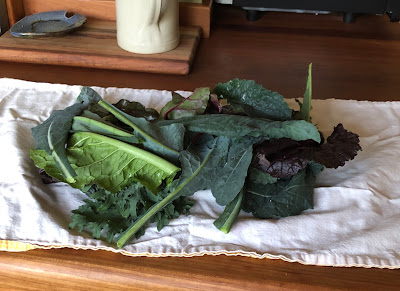
Bamboo hoops supporting thin plastic sheeting haven't been exactly pretty, but they are effective.  We had a lovely dinner last night based on greens harvested from these hoops.
Tuscan kale and purple mustard under plastic cover
Tuscan kale and purple mustard
Probably they'd been fine without any cover, especially the Tuscan kale, but I'd transplanted them late from the cold frame flat.

And, I was worried about an errant woodchuck (maybe emerging on a warm day?) or one of the young deer coming in from the powerline corridor munching through these in a flash.  At least the plastic tucked around these plants kept the herbivores out!

Cold frame with leeks, lettuce, and greens (barricaded against squirrels, etc.)
My musing about woodchucks led me to a search that found this post, by naturalist Marcia Bonta, that related a finding that woodchucks don't actually hibernate in South Carolina, according to a researcher at Clemson University.  Hmm, that's where I work (and live nearby).  So I wasn't that far off in my (perhaps) concern. Yikes!

Sunday, January 29, 2012

Gardening 'products'

There are a lot of garden products marketed to us (certainly in North American markets). 

Most of them are in 'the just say no' category, with the exception of organic nutrients and minerals, depending on our soil and its condition.

I was reminded of this at a garden club gathering this afternoon, and then again this evening, reading a post at A Way to Garden about the (now-collapsed) association between Scotts MiracleGro and the National Wildlife Federation. 

Quite odd, I thought (although I hadn't heard about it previously) and apparently it created a firestorm of opposition among NWF supporters and others over the last week or so.

We basically need to create healthy, very fertile soil for our (pampered) vegetables and decent (but also healthy) growing conditions for everything else.

We don't need a lot of 'stuff' to do that -- just keep all the organic matter your property produces at home, import (as locally as possible) more leaves, manure if needed, mineral elements, etc. as you need. 

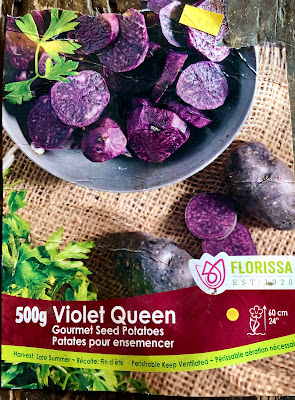
But, there's usually not much need for pesticides in a balanced and diversified growing environment;  maybe a barrier spray or insecticidal soap, or organic material for something that gets out of hand (I used some hand-me-down Spinosad spray (thanks, CEN!) against Colorado potato beetles last season).  But I'd planted potatoes in the same general location for several years, so I was 'breaking' the rotation rules, so it was no surprise to see them.

Marketing to garden consumers is all about needing stuff to make your 'yard' beautiful, bountiful, and pest-free. 

I think I'll just concentrate on gardening for nature.

Saturday, January 28, 2012

Red maple

Acer rubrum (red maple) is a wonderful native tree in the Southeastern US (and the Northeast, too). Check out its range.

There are numerous cultivars, selected primarily for their fall leaf color.  But equally interesting, although maybe not so remarkable, is the lovely winter color of recent growth.  It can be reddish (that's what caught my eye), but also more towards yellow, too.

What are those reddish young trees along the edge of the highway, I asked my gardening companion?  Maples, maybe, I thought?  And, happily, he's done his research (see the book link on the sidebar), so he knew new growth on red maples was reddish in color, so my idea was confirmed.  And as I look around where red maples have been planted, it's clear that new growth is definitely colorful!

And we're already seeing flowers of red maple on the ground both at home in the Piedmont and in the mountains.  They're always among the first flowering trees in our native flora, and maybe a bit ahead this year, with a mild winter.

red maple flowers (from cas.vanderbilt.edu): click on image for link

Friday, January 27, 2012

Sugar snap peas and snow peas

Even though we're in the final days of January, spring is around the corner.  I'll be planting sugar snap and snow peas this weekend, hoping for a long cool spring, without too many damp (seed-rotting) days.  I'll plant more later, too, buffering the odds of germination, emergence, and growth.

My garden blogging friend Randy planted his peas last Thursday, following the thickly planted strategy recommended by his spouse Meg.  An excellent approach!

The most productive peas that I've ever seen (this were being commercially grown to be sure) were in the mountain highlands of Vietnam, in the area around Dalat.  

This is an amazingly productive temperate vegetable growing area, with high tunnels and covered areas growing LOTS of vegetables for Asian markets and beyond. This was a post I made about this time two years ago about planting cool-season vegetables.

Snow peas ready to harvest in Dalat, Vietnam (2010)

Thursday, January 26, 2012

Backyard (garden) birds

Out in the Garden today with a group of volunteer education program guides, we heard some of our resident birds.  It wasn't the focus of our program, to be sure, as it was an orientation series, but I noticed the uptick in calls, with another mild winter day.

Our resident Northern Cardinals, Carolina Wrens, and Tufted Titmice were actively calling, along with a flock of (seasonal) Cedar Waxwings foraging for fruits. We're hearing woodpeckers and our resident red-shouldered hawks, too, calling as they're foraging or hunting.

I received an excellent link to a Bald Eagle webcam today at Norfolk Botanical Garden (courtesy of a botanical sign company).  Checking it out was amazing  --  I guess with bald eagles that they reuse and repair their nest year after year, so the web cam works, but totally cool.

Here's the link to the Eagle cam info page.  It takes awhile to load, after you click on the web cam link, but is well worth it!


Tuesday, January 24, 2012

Crocus and snowdrops

The early spring crocuses in the shady bed outside the breakfast room are flowering now, and I spotted a early snowdrop in front of the house today.  Spring is definitely early, and we had a lovely clear afternoon today that smelled of spring. 

crocuses from a previous year
I weeded some winter annuals out of the vegetable beds, and put some pre-sprouted spinach seeds in a flat, too.  I'm itching to sow cool-season greens, but I need to check soil temperatures before being too hasty.

My camera (an aging, but sturdy Nikon D100 with a nice lens) is languishing up in the mountains, so I don't have photos.  I guess I could use our very nice small Panasonic camera that my gardening companion favors for travel photos, but I'm not that familiar with it.  And I'd have to hunt around for the right download cord, etc. etc.


Monday, January 23, 2012

Robin flocks

a robin eating fruit (from a royalty-free photo used in The Nature of Clemson)
It's been busy at the hollies over the last few days. 

Large numbers of robins have (200+) been devouring the berries on the row of Ilex opaca cultivar hollies above the education building at the garden where I work. They visit the hollies, collect berries, then retreat nearby to eat them, then repeat.

This morning, in rain, before I began a program, the circuit from holly to perching trees nearby  (in this case, large Cryptomeria and Southern Magnolia) was in full swing.  Their continuous melodic murmurs were more than evident outside, but at a lower level from inside the building.

The year-round vegetable gardening class participants were fascinated, and we peered outside for a bit before we started the class. By the end of the morning, the flock had moved to the lower row of hollies (also Ilex opaca cultivars) below the nature center (the lower level of the building), presumably finished with the upper row after 4 days of feasting.

Sunday, January 22, 2012

Categories, labels, and indices

I've admired the nice category listings on other blogs. What a good thing to do, I thought.  Not all of my posts are profound, but some are worth reading again.  I enjoy doing that, and maybe others would, too, I'm thinking. Hmm. 

Investigating, I discovered that Google's labels (on their blogger platform) can serve as surrogate categories (that makes sense).  But then I realized that my labels (over years of blogging and a LOT of posts) created a list (triple-columned) totaling over 14 pages.  Hrrhmp. 

That means I need to go through all of those labels and consolidate them into reasonable categories and revise the post labels, before being able to put up an nicely organized category sidebar.  Yikes!

But maybe that won't be so hard. 

About half of my posts are about wildlife gardening and natural history observations, with the other half about growing vegetables, and all of them are about natural gardening.  (We just say no to pesticides in our gardens and inside the house, with a brief acceptance for glyphosate for controlling bermuda grass and poison ivy.)

Saturday, January 21, 2012

Rain

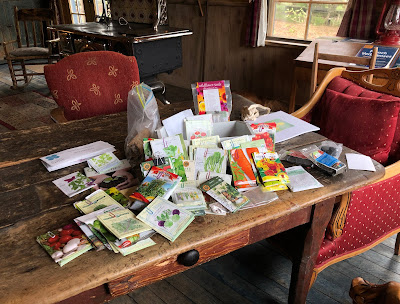
The soil is soggy from lots of rain over the last couple of days.  (Alas, it was not a outdoor gardening day today, but I finished ordering warm-season seeds.  Gardening is an optimistic hobby, even as I contemplate the (hungry) woodchucks and deer that could chew things down in a flash.)

It's been a warm rain, with thunder and lightning, most unusual for for winter. 

It's needed though, and although we've had fairly normal levels of rainfall recently, groundwater and reservoir levels are still low.

Thursday, January 19, 2012

Signs of spring

This shouldn't be a topic for reflection in mid-January, but we're definitely seeing signs of (premature) spring in the Piedmont. 

All of the Asian species that normally flower in winter are in full swing and the early-spring flowering shrubs and trees  (Japanese apricot, Prunus mume, for example) are also in full flower, almost a month ahead of 'normal.'

More interestingly, native birds are following the cues, and behaving more like it's February rather than January.  Vocalization, flocking behavior, courtship, and probably all sorts of things that I haven't noticed seem much more evident than usual in January.   The last two winters were quite severe for the SE and spring came late, providing a (maybe significant) contrast.

A radio show colleague remarked that the Farmer's Almanac predicts a cold February.

National Weather Service Climate Predication Center map
I haven't looked at that (nor do I know how the Almanac comes up with their predictions), but we'll see. 

I like to periodically look at the National Weather Service Climate Prediction Center's outlook maps for drought.  I think that their temperature outlook might be interesting as well.  Hmm, they're suggesting above normal temperatures for February (check out the graphic above).
Related Posts with Thumbnails